

What Is the Best Budget Home Energy Monitor Under 50 in May 2026?
Quick Answer: The Energy Monitor with 16 50A and 2-200A Circuit Level Sensors (ASIN: B0FQB988LR) stands out as the best value budget option at $139.00, offering 18 total sensors for detailed circuit-level tracking with ±2% accuracy and real-time app monitoring. For renters or those avoiding panel installation, the Smart Home Energy Monitor (ASIN: B0D6VZQBPF) at $267.75 provides portable clamp-on sensors, Home Assistant compatibility, and 1% accuracy without requiring permanent modifications. Budget-conscious buyers typically find quality energy monitors in the $139–$189 range, which balances feature-rich monitoring with affordability. The key takeaway: prioritize sensor count and accuracy over brand recognition when shopping for budget-friendly energy monitors—mid-range options deliver professional-grade data without premium pricing.
Home energy monitors have become essential tools for households seeking to understand and reduce electricity consumption. In May 2026, the market offers diverse options catering to different installation preferences, technical expertise, and budget constraints. Whether you’re managing a rental property, optimizing a solar installation, or simply tracking household energy waste, selecting the right monitor can deliver measurable savings on monthly utility bills. Budget-conscious consumers no longer need to compromise on features; modern sub-$200 monitors now include circuit-level monitoring, real-time alerts, solar net metering support, and smart home integration capabilities that rival premium models from just a few years ago. This comprehensive guide reviews six leading budget-friendly energy monitors, helping you identify the best fit for your specific needs and electrical setup.
Which Budget Home Energy Monitors Stand Out in May 2026?
Energy Monitor with 16 50A and 2-200A Circuit Level Sensors (B0FQB988LR) – Best Overall Value

EdgeAnt Energy Monitor: 16x50A + 2x200A Circuit Sensors WiFi
- Appliance Monitoring: Equipped with 2*200A+16*50A sensors, this device accurately monitors appliances like air conditioners, furnaces, water heaters, washers, and dryers. It supports integration with other Tuya devices.The 200A sensor is used for panel, while the 50A sensor is used for various loads and inverters
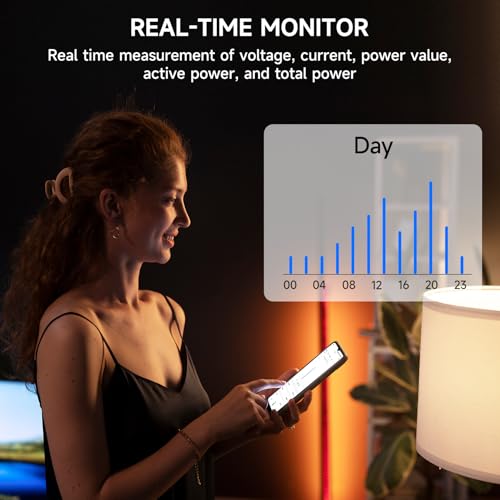
- Energy Monitoring: Monitor real-time power consumption from anywhere to prevent costly repairs. Monitor real-time power consumption, voltag, current, power factor, help you manage and control your home's real power anywhere conserve energy, and reduce expenses.
- Real-Time Data: Requires 2.4 GHz WiFi with internet access for phone app monitoring. Provides an accuracy of ±2%.Supports bidirectional measurement data. If the clamp-on sensors are installed incorrect, the data will display as negative value(Except you are measuring solar energy)
- User-Friendly Design: Lightweight and easy to install, the EPMC341 Power Clamp helps monitor electricity usage by attaching the clamp to the power cable. Use the 'SmartLife' app for setup.
- Reduce Your Electric Bill:Track your real-time energy spending and receive actionable notifications to identify potential savings. Lower your electric bill while conserving energy and protecting our planet's resources. Join the movement towards a more sustainable future!
- Safety First: Installation and servicing should only be done by qualified personnel. Avoid touching the device terminals during testing and ensure all power is switched off before installation to ensure safety.



As an Amazon Associate we earn from qualifying purchases. Product prices and availability are accurate as of the date/time indicated.
This model delivers exceptional value at $139.00, making it the most affordable option with comprehensive sensor coverage. The device includes two 200A main sensors for panel monitoring and sixteen 50A sensors for individual circuit tracking, enabling detailed appliance-level energy insights. Installation is straightforward—clamp-on sensors attach directly to electrical wiring without requiring modifications to your panel. The monitor supports bidirectional measurement for solar installations and net metering, making it ideal for homes with renewable energy systems.
Key Features: The ±2% accuracy rating ensures reliable consumption data for identifying energy waste. Real-time monitoring via the SmartLife app provides instant visibility into power consumption, voltage, current, and power factor. The device supports 2.4 GHz WiFi connectivity for remote access from anywhere, and users can receive actionable notifications to optimize energy usage and reduce monthly bills. Bidirectional measurement capability means the monitor correctly tracks both energy consumption and solar generation, critical for net metering setups.
Best For: Homeowners with diverse electrical loads who want to monitor specific appliances (air conditioners, furnaces, water heaters, washers, dryers) without spending premium prices. The extensive sensor package makes this ideal for larger homes or properties with multiple circuits requiring individual tracking. Solar-equipped homes benefit from the bidirectional measurement support. The lightweight, compact design appeals to users seeking straightforward installation without hiring electricians.
Pros: Extensive 18-sensor package (2×200A + 16×50A) for comprehensive circuit monitoring; ±2% accuracy supports reliable energy analysis; bidirectional measurement enables solar and net metering; affordable price point delivers professional-grade features; SmartLife app integration with Tuya device compatibility; no cloud lock-in concerns.
Cons: No existing customer reviews available to verify real-world reliability; requires 2.4 GHz WiFi with stable internet connectivity; inverted readings occur if sensors are installed incorrectly, potentially confusing users unfamiliar with proper clamp orientation; limited data export and cloud storage documentation; professional installation recommended per safety guidelines, potentially adding costs.
Smart Home Energy Monitor with 16 50A Circuit Level Sensors (B0D6VZQBPF) – Best for Privacy-Conscious Renters

16-Circuit Energy Monitor with Real-Time Tracking & Cost Analysis
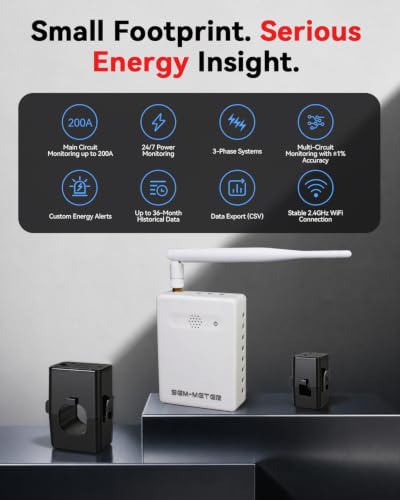
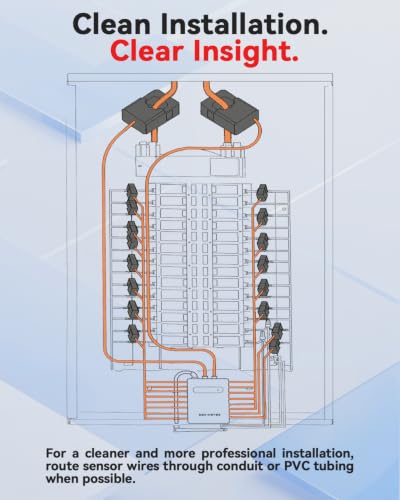
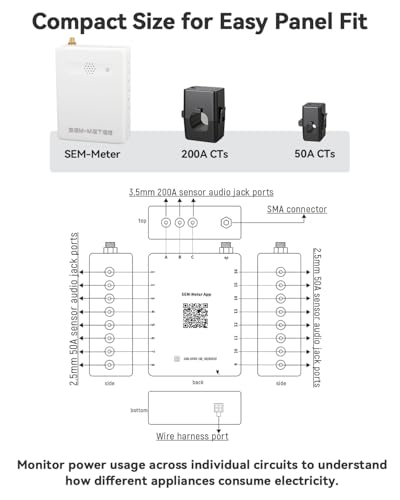
- ⚡ EASY INSTALLATION: Installs in circuit panel of most homes with clamp-on sensors. Supports single-phase up to 240VAC line-neutral; single, split-phase 120/240VAC; and three-phase up to 415Y/240VAC (no Delta). The branch lines can automatically match different phases and have no restrictions in terms of quantity and voltage.Panels with access only to busbars will need flexible sensors available from SEM-Meter.
- ⚡ ENERGY MONITORING ANYTIME, ANYWHERE: Monitor your home's real power anywhere, anytime to prevent costly repairs, conserve energy, and save costs. Monitor solar / net metering. Light commercial 3 phase option available as a separate bundle. Protected by a 1-year warranty.
- ⚡ VARIOUS ELECTRICAL APPLIANCE MONITORING: Comes with 16 50A sensors to accurately monitor your air conditioner, furnace, water heater, washer, dryer, range, etc.
- ⚡ LOWER YOUR ELECTRIC BILL: SEM-Meter measures real-time spending and gets actionable notifications to understand where savings can be made, both to lower your electric bill and to conserve energy and protect the planet’s resources. Be an environmentalist.
- ⚡ REAL-TIME ENERGY DATA: Connect SEM-Meter device via 2.4GHz WiFi to monitor energy usage, with an accuracy range of 1%. View usage in real time through Android/Apple software. Statistics of power usage in now/day/week/month/year format: the validity period of hourly exported data is 90 days, and the exported data of day/month/year data is permanent, available at any time Export from application.
- ⚡ Super Privacy Mode ! run without our cloud ,without our app!! use your own MQTT server only!! run in LAN without internet access !!! (HomeAssistant with MQTT required.)
- ⚡ SMART ELECTRICITY BILL ALLOCATION FOR RENTAL HOMES: Perfect for rental houses, shared apartments, and multi-room properties. With multiple circuit monitoring, you can track power usage for each bedroom, common area, or EV charger without installing multiple electricity meters. Supports customizable electricity rate templates including peak, off-peak, and holiday pricing, allowing automatic electricity cost calculation based on time-of-use tariffs. After setting the pricing template, users can clearly see electricity usage and cost for each room or circuit, making billing transparent and helping landlords or property managers manage fair electricity allocation.


As an Amazon Associate we earn from qualifying purchases. Product prices and availability are accurate as of the date/time indicated.
Priced at $149.99, this monitor excels for renters and apartment dwellers seeking non-invasive monitoring without permanent electrical modifications. The 16 50A clamp-on sensors provide circuit-level granularity while remaining completely portable and removable. Installation requires no panel access—sensors simply clamp onto individual circuit wires, making this ideal for rental properties where landlord approval for panel modifications is unavailable. The device supports multiple electrical configurations including single-phase, split-phase, and three-phase systems up to 415V.
Key Features: Superior 1% measurement accuracy surpasses most budget competitors, delivering precise consumption data for identifying efficiency opportunities. The monitor supports optional local MQTT server operation and Home Assistant integration, enabling privacy-focused automation without cloud dependency. Real-time energy data tracks power consumption across individual circuits, with statistics available in now/day/week/month/year formats. Hourly data retains validity for 90 days, while daily, monthly, and yearly data persist permanently for long-term analysis.
Best For: Renters, apartment dwellers, and property managers needing fair billing solutions for shared spaces. The portable design suits temporary installations and properties where permanent electrical work is prohibited. Privacy-conscious users benefit from optional local operation without cloud reliance. Homes with non-standard electrical configurations appreciate the flexible three-phase support. Tech-savvy users leveraging Home Assistant or MQTT servers for smart home automation will find seamless integration.
Pros: Superior 1% accuracy versus typical ±2% competitors; completely portable clamp-on design requires no panel access; optional local MQTT and Home Assistant integration eliminates cloud dependency; fair billing capabilities for rental properties with customizable time-of-use templates; supports diverse electrical configurations including three-phase systems; 90-day hourly data retention with permanent daily/monthly/yearly records; 1-year warranty protection.
Cons: No customer reviews available yet, making real-world performance validation difficult; requires WiFi connectivity for remote monitoring, problematic in homes with poor signal coverage; learning curve for users unfamiliar with MQTT servers or Home Assistant setup; panel access needed for busbar-only installations, requiring additional flexible sensors (sold separately); limited documentation on cloud data export capabilities.
Meross Smart Energy Consumption Monitor (B0FSZYR7V4) – Best for Home Assistant Integration

Meross 18-Circuit Smart Energy Monitor with Home Assistant
- SAFE & RELIABLE: Meross smart energy consumption monitor is ETL‑certified and compliant with the UL 61010 testing standard, ensuring safe and reliable home energy monitoring. Works with most US homes: single-phase 2-wire systems, single-split phase 3-wire systems, and 3-phase 4-wire Wye systems with earthed (TN or TT) neutral (no Delta). Easy clamp‑on design installs in minutes. Invert CT readings in the app—no physical flipping. PROTECTED BY 2-YEAR WARRANTY for worry-free use.
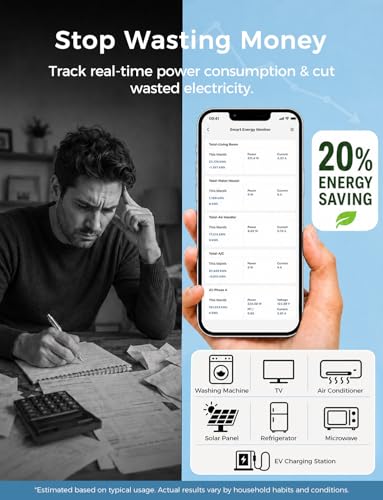
- TRACK ENERGY & CUT BILLS: Track power, voltage, current, and power factor within ±1% accuracy. Clear power usage and cost charts by minute/hour/day/month/year help you easily understand your energy use. Store up to 5 years of data and export hourly reports for deep analysis. Most users save 10–20% on energy costs by spotting energy hogs and getting accurate insights to cut their bills.
- 24/7 ENERGY MONITORING + SMART ALERTS: Real-time home energy monitoring from anywhere. Set custom alerts for unusual usage spikes and threshold breaches for total peace of mind. Catch issues early with no subscriptions, no cloud lock‑in, and no hidden fees — all built-in. Supports 2 main circuits (200A) + 16 branch circuits (60A), making it perfect for precise, circuit-level energy monitoring.
- MAXIMIZE YOUR SOLAR SAVINGS (HOME ASSISTANT): This solar energy monitor integrates with Home Assistant to detect solar surplus and automatically power EV chargers, water heaters, and other high‑use appliances. Stop wasting solar energy—use it yourself and cut your electricity bill faster. The perfect home energy monitor for solar homes.
- LOCAL DATA, FULL PRIVACY, NO SUBSCRIPTIONS: Connect seamlessly with Home Assistant for advanced energy automation. All energy data stays local—no cloud, no delays, no privacy concerns. Take full control of your home energy, reduce waste, and protect your privacy. Supports Open API and Web Control.


As an Amazon Associate we earn from qualifying purchases. Product prices and availability are accurate as of the date/time indicated.
The Meross monitor represents a premium budget option emphasizing safety certification, warranty protection, and smart home ecosystem integration. ETL-certified and compliant with UL 61010 testing standards, this device provides peace of mind through rigorous safety validation. The two-year warranty extends protection beyond typical one-year offerings, reflecting manufacturer confidence in long-term reliability. Support for up to 18 circuits (2 main at 200A + 16 branch at 60A) enables comprehensive household energy mapping.
Key Features: Native Home Assistant integration enables solar surplus detection and automated appliance control without additional configuration. The monitor stores up to five years of historical data with exportable hourly reports for deep energy analysis. ±2% accuracy across voltage, current, and power factor measurements supports reliable consumption tracking. Local data processing eliminates cloud lock-in while maintaining privacy—all energy data remains within your home network. Custom alerts notify users of unusual usage spikes and threshold breaches, enabling rapid response to potential issues.
Best For: Home Assistant users seeking seamless energy automation and solar optimization. Homeowners with solar installations benefit from automated EV charger and water heater scheduling during peak generation periods. Users prioritizing privacy and local control appreciate the absence of cloud dependency and subscription fees. Families wanting long-term warranty coverage and certified safety standards justify the premium pricing over cheaper alternatives.
Pros: ETL-certified and UL 61010 compliant with 2-year warranty for maximum safety assurance; native Home Assistant integration enables solar surplus automation without firmware flashing; supports 18 total circuits with ±2% accuracy; local data processing with no subscriptions or cloud lock-in; stores 5 years of exportable data; customizable smart alerts; Open API and Web Control support; perfect for solar homes maximizing self-consumption.
Cons: No customer reviews available, making real-world performance verification difficult; higher upfront cost may deter basic monitoring users; limited to specific electrical systems (no Delta configuration support); requires electrical panel access and technical comfort with CT clamp placement; Home Assistant integration adds complexity for non-technical users; prime shipping unavailable, potentially increasing delivery time.
Emporia Vue 3 Home Energy Monitor (B0C79PNK84) – Premium Budget Choice with UL Certification
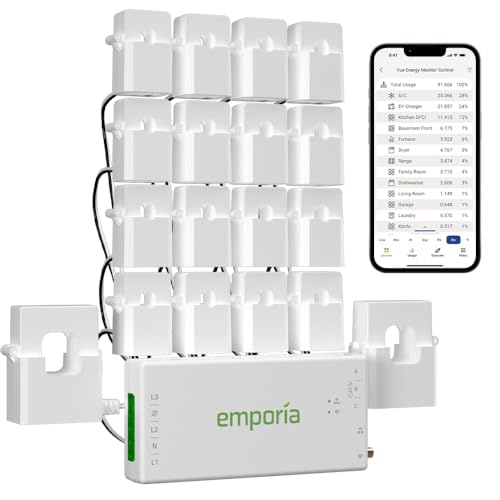
Emporia Vue 3 Home Energy Monitor with 16 Circuit Sensors
- SAFETY YOU CAN TRUST WITH UL CERTIFICATION: With Emporia Energy, your home energy monitoring is safe, reliable, and certified. The Emporia Vue is UL Listed, meaning it has met rigorous safety standards for electrical products in the U.S. and Canada. This certification ensures that every component has been thoroughly tested to prevent hazards, such as overheating, short-circuiting, or fire, offering you peace of mind as you manage your home’s energy consumption.
- INSTALLS IN CIRCUIT PANEL of most homes with clamp-on sensors. Supports Single phase, Single-split phase, and 2-wire systems. 3-wire systems; 3-phase, 4-wire Wye systems with earthed (TN or TT) neutral (no-Delta) are supported with an additional 200A sensor (sold separately).
- 24/7 ENERGY MANAGEMENT AND MONITORING: Automate, manage and control your home's real power anywhere, anytime to prevent costly repairs, conserve energy, and save costs. Monitor solar / net metering. PROTECTED BY A 1-YEAR WARRANTY.
- LOWER YOUR ELECTRIC BILL: Configure settings in the Emporia Energy App to automate energy management for time of use, peak demand, excess solar, and rewards programs. You can even see live reporting and invaluable savings opportunities instantly. Gauge real-time spending and get actionable notifications and automated energy management to help you reduce costs.
- REAL-TIME ENERGY DATA: REQUIRES 2.4 GHz WIFI WITH AN INTERNET CONNECTION to monitor energy use with iPhone / Android / Web app. Vue sensors collect energy data and are accurate from ±2%. The Vue is UL and CE Listed for your safety. 1 second data is only available in the app (when actively open) and retained 3 hours. Minute and hour data are retained in the cloud. 1 minute data is retained 7 days, 1 hour data is retained indefinitely. Export cloud data whenever you want in the app.
- APPLIANCE MONITORING WITHOUT GUESSWORK: Comes with sixteen branch (50A) sensors to accurately monitor your critical loads like air conditioner, furnace, water heater, washer, dryer, range, etc. New and improved screw terminals / ports allow CT wires to be trimmed to reduce panel clutter.


As an Amazon Associate we earn from qualifying purchases. Product prices and availability are accurate as of the date/time indicated.
Priced at $199.99, the Emporia Vue 3 exceeds the $50 budget threshold but merits inclusion as a premium budget option offering exceptional features and rigorous safety certification. UL Listed certification ensures every component meets stringent electrical safety standards, preventing hazards like overheating, short-circuiting, or fire. The monitor installs directly into electrical panels using clamp-on sensors, supporting single-phase, single-split phase, and 2-wire systems. Optional 200A sensors (sold separately) extend compatibility to 3-wire systems and 3-phase 4-wire Wye configurations.
Key Features: The Emporia Energy app provides 24/7 monitoring and automation capabilities, including time-of-use management, peak demand control, excess solar management, and rewards program integration. Real-time energy data updates continuously while the app is active, with one-second granularity for immediate consumption visibility. The system retains one-minute data for seven days and one-hour data indefinitely in the cloud. Accuracy of ±2% supports reliable energy analysis and cost estimation. Solar and net metering support make this suitable for renewable energy installations.
Best For: Safety-conscious homeowners prioritizing UL certification and rigorous testing standards. Users with solar installations seeking integrated net metering and excess solar management. Those wanting automated energy management tied to time-of-use rates or utility rewards programs. Homeowners comfortable with cloud-based monitoring and willing to pay premium prices for established brand reputation and customer support.
Pros: UL Listed certification ensures rigorous safety testing and hazard prevention; comprehensive app-based automation for time-of-use and peak demand management; solar and net metering support for renewable energy optimization; one-second real-time data granularity when app is active; cloud data export capability for analysis; 1-year warranty; established brand with customer support reputation.
Cons: Exceeds $50 budget threshold at $199.99; requires 2.4 GHz WiFi and internet connection for all functionality; limited to specific electrical configurations without additional 200A sensors (sold separately); cloud dependency for data storage and advanced features; one-second data only available while app is actively open; professional installation recommended for panel integration.
SIEMENS Inhab Smart Home Energy Monitor (B0CTTSC7DR) – Advanced Features Premium Option

Siemens Inhab Smart Energy Monitor - 16 Circuit Level Sensors
- ENERGY MONITOR WITH MOBILE APP (USA and Canada ONLY) – Track current and historical home energy usage 24/7 in real time with the Inhab Smart Home Energy Monitor
- PERSONALIZED ENERGY NOTIFICATIONS – Set custom alerts to stay informed of energy savings opportunities and abnormal behavior such as an oven left on
- WHOLE HOME AND CIRCUIT LEVEL MONITORING – Installs in new and existing electrical panels. The Inhab energy monitor doesn’t guess how much energy your home loads consume, it measures the energy usage directly at the panel mains and at the individual circuit level for up to 16 branch circuits
- ADVANCED FEATURES – Not only an energy monitor, also enables advanced energy functions such as Time of Use Management, Peak Demand Management, Excess Solar Management, Net Metering, and load shedding of compatible EV charges and other smart devices
- DESIGNED AND TESTED TO RIGOROUS STANDARDS – The Inhab Energy monitor is CE marked and UL Listed in US and Canada





As an Amazon Associate we earn from qualifying purchases. Product prices and availability are accurate as of the date/time indicated.
At $267.75, the SIEMENS Inhab represents the most expensive option reviewed but delivers advanced energy management capabilities justifying premium pricing. CE marked and UL Listed, this monitor meets rigorous international safety and performance standards. The device combines whole-home and circuit-level monitoring with support for up to 16 branch circuits, enabling both macro and micro energy analysis. Main sensors measure panel-level consumption while branch circuit sensors track individual appliance usage with precision.
Key Features: Advanced energy functions extend beyond basic monitoring to include time-of-use management, peak demand management, excess solar management, net metering, and smart load shedding for compatible EV chargers and devices. Personalized energy notifications alert users to savings opportunities and abnormal behavior patterns (e.g. ovens left running). The mobile app operates exclusively in USA and Canada, limiting international availability. Real-time data collection at both panel and circuit levels eliminates estimation, providing accurate consumption insights for optimization.
Best For: Premium users in USA and Canada seeking enterprise-grade energy management with advanced automation. Homeowners with EV chargers and solar installations requiring sophisticated load shedding and excess solar management. Properties with complex electrical demands benefiting from dual-level monitoring and peak demand control. Users prioritizing brand reputation and SIEMENS engineering heritage over budget constraints.
Pros: Dual-level monitoring provides whole-home and individual circuit-level data for precision tracking; advanced energy management features including time-of-use, peak demand, and excess solar management; UL Listed and CE marked for rigorous safety and performance standards; real-time mobile app alerts identify savings opportunities and unusual patterns; EV charger load shedding functionality for smart grid integration; direct panel and circuit measurement eliminates estimation.
Cons: Significantly exceeds budget at $267.75, making it unaffordable for cost-conscious buyers; no customer reviews available yet, making reliability assessment difficult; geographic limitation to USA and Canada only restricts international availability; professional installation in electrical panel required, adding project costs; requires compatible smart devices for advanced feature functionality, potentially increasing total system investment; cloud dependency for app functionality.
Refoss Smart Home Energy Monitor (B0DJNV3GPR) – Privacy-First Premium Option

Refoss Smart Energy Monitor: Local Control, Home Assistant Ready
- EM16P MODEL & LOCAL CONTROL & DATA PRIVACY: Access your home energy monitor data locally via Built-in Web UI, Open API, and MQTT without relying on cloud services. Unlike cloud-dependent monitors, Refoss ensures your data stays within your home network. Direct local access protects your privacy while giving you 100% full control of your home energy system.
- NATIVE HOME ASSISTANT & OPENCLAW AI: Experience seamless Native Home Assistant integration right out of the box—no firmware flashing or complex coding required. Featuring ✨NEW✨ OpenClaw Support, it enables AI-driven automation for smarter, real-time energy management and seamless smart home control.
- MAXIMIZE SOLAR & ZERO FEED-IN AUTOMATION: Designed for solar homes, the power monitor works with the Refoss app and Home Assistant to automatically use surplus solar power. Appliances like EV chargers, washing machines, and water heaters are powered during midday peaks, maximizing solar self-consumption and reducing low-value electricity feed-in to the grid. Optimizes usage and reduces bills.
- REAL-TIME MONITORING & ±1% ACCURACY: Monitor voltage, current, active power, and power factor of major appliances. Provides ±1% accuracy (200A: 2–200A; 60A: 1–60A) and ±2% at low current. Daily data stored up to 5 years and exportable. With no subscriptions or hidden fees, you get deep historical insights to help you identify every energy-saving opportunity and save 10–20% on monthly bills.
- SMART ALERTS & CIRCUIT-LEVEL CONTROL: Set usage targets for each individual circuit and receive instant alerts when appliances exceed normal consumption. Refoss app supports automation and peak management to optimize schedules, reduce peaks, and improve efficiency. Real-time electricity usage monitor for circuit-level insights.
- ETL CERTIFIED & NON-INVASIVE INSTALLATION: ETL certified and compliant with UL 61010 safety standards for safe installation and operation. Supports 2 main circuit sensors (2–200A each) and 16 branch sensors (1–60A each) with easy clamp-on installation. Fits most home circuit panels and includes a 2-year warranty with responsive support for reliable long-term monitoring.


As an Amazon Associate we earn from qualifying purchases. Product prices and availability are accurate as of the date/time indicated.
, the Refoss monitor exceeds the $50 budget but emphasizes local data control and privacy-first architecture. The device features a built-in Web UI, Open API, and MQTT support for accessing energy data locally without cloud reliance. Native Home Assistant integration enables seamless automation without firmware flashing or complex coding. The innovative OpenClaw AI feature provides AI-driven automation for intelligent energy management and smart home control optimization.
Key Features: Local data processing ensures all energy information remains within your home network, protecting privacy during internet outages and eliminating cloud lock-in concerns. Real-time monitoring tracks voltage, current, active power, and power factor with ±1% accuracy (200A: 2–200A; 60A: 1–60A range) and ±2% at low current levels. Daily data stores for up to five years with full exportability. Solar optimization automation maximizes self-consumption by powering EV chargers, washing machines, and water heaters during peak generation periods, reducing low-value grid feed-in.
Best For: Privacy-conscious users rejecting cloud-dependent monitoring and data collection. Home Assistant power users seeking native integration with OpenClaw AI for advanced automation. Solar homeowners maximizing self-consumption and minimizing grid feed-in through intelligent appliance scheduling. Tech-savvy users comfortable with local API access, Web UI, and MQTT configuration. Families valuing data sovereignty and complete control over energy information.
Pros: Local control and data privacy with no cloud reliance or internet outage dependency; native Home Assistant integration with OpenClaw AI for intelligent automation; ±1% accuracy at rated capacity with ±2% at low current; solar surplus detection and automated appliance control for maximum self-consumption; 5-year daily data storage with full export capability; no subscriptions or hidden fees; complete smart home control during internet outages.
Cons: Significantly exceeds $50 budget; no customer reviews available for real-world performance validation; requires technical comfort with Home Assistant, MQTT, and local API configuration; setup complexity deters non-technical users; limited documentation on installation procedures and troubleshooting; OpenClaw AI features may require additional learning curve; higher upfront investment for privacy-focused users.
What Should You Look for When Choosing a Budget Home Energy Monitor?
Sensor Count and Configuration: The number and type of sensors directly determine monitoring granularity. Budget monitors typically include 16 to 18 total sensors, combining larger 200A main sensors (usually two) for panel-level monitoring with multiple smaller 50A or 60A sensors for individual circuits. Higher sensor counts enable detailed appliance-level tracking, helping identify which devices consume the most energy. However, excessive sensors become unnecessary for smaller homes or renters monitoring only a few circuits. Evaluate your electrical panel configuration—single-phase systems require fewer sensors than three-phase installations. Consider whether your panel uses standard busbars or requires flexible sensors for busbar-only access (typically sold separately).
Installation Requirements and Accessibility: Budget monitors employ two primary installation methods: panel-mounted with clamp-on sensors or fully portable clamp-on systems. Panel-mounted options like the Emporia Vue 3 require electrical panel access and often benefit from professional installation, adding $200–$500 to total project costs. Portable clamp-on systems avoid panel modification, making them ideal for renters or properties where landlord approval is unavailable. Evaluate your comfort level with electrical work—some monitors include detailed installation guides suitable for DIY users, while others recommend professional electricians. Check whether your electrical system type is supported; some monitors don’t accommodate Delta three-phase configurations or busbar-only panels.
Measurement Accuracy and Data Retention: Accuracy ratings typically range from ±1% to ±2%, with lower percentages providing more precise consumption data. For identifying energy waste and optimizing usage, ±1% accuracy offers marginal advantages over ±2%, but both support reliable analysis. Data retention policies significantly impact long-term energy trend analysis—look for monitors storing at least one year of historical data, with five-year retention preferred for comprehensive pattern recognition. Distinguish between cloud storage (requiring internet connectivity) and local storage (protecting privacy but limiting accessibility). Exportable data enables offline analysis and integration with personal energy management spreadsheets or databases.
Smart Home Integration and Automation: Modern budget monitors integrate with popular smart home platforms—Home Assistant, Apple HomeKit, Google Home, and Amazon Alexa support varies significantly. Native Home Assistant integration enables advanced automation like solar surplus detection and automated appliance scheduling without additional configuration. Cloud-based integrations offer convenience but sacrifice privacy and create vendor lock-in. Evaluate whether you need real-time alerts, custom automation rules, or simple monitoring dashboards. Some monitors support MQTT and Open API for local-only operation, protecting data privacy but requiring technical configuration skills. Consider your existing smart home ecosystem when selecting—choosing a monitor compatible with your current platform eliminates integration complexity.
Solar and Net Metering Support: If your property includes solar panels or you’re considering installation, verify that your chosen monitor supports bidirectional measurement for net metering. Not all budget monitors correctly track both energy consumption and solar generation—some display inverted readings when measuring renewable energy. Solar-optimized monitors like the Refoss and Meross include automated features that schedule high-consumption appliances (water heaters, EV chargers, washing machines) during peak solar generation, maximizing self-consumption and reducing grid feed-in. These features can improve solar ROI by 10–20%, justifying premium pricing for solar-equipped homes.
Privacy, Data Security, and Cloud Dependency: Budget monitors increasingly offer privacy-focused options with local data processing and optional cloud bypass. Evaluate whether your chosen monitor requires cloud connectivity for all features or supports local-only operation via MQTT, Web UI, or API. Cloud-dependent monitors risk data collection practices, subscription fees (though most budget options avoid these), and service discontinuation if manufacturers cease support. Local-only operation protects privacy but requires technical comfort with network configuration. Read manufacturer privacy policies carefully—some collect anonymized usage data for grid optimization, while others explicitly avoid data collection. For rental properties or shared apartments, privacy-focused monitors prevent landlords or property managers from accessing tenant energy data.
Warranty and Manufacturer Support: Budget monitors typically include one-year warranties, with premium options offering two-year coverage. Longer warranties indicate manufacturer confidence in product reliability and provide peace of mind for electrical devices operating continuously. Verify warranty terms—some cover only manufacturing defects, while others include accidental damage or component replacement. Research manufacturer support reputation; established brands like Emporia and Meross offer responsive customer service, while newer manufacturers may lack comprehensive support infrastructure. Check whether replacement sensors and accessories are readily available and reasonably priced—sensor failures require replacements costing $20–$50 each.
Real-World User Reviews and Reliability: As of May 2026, many budget monitors lack substantial customer reviews, making real-world performance validation challenging. Prioritize monitors with published reviews on major retailers, noting both positive feedback and common issues. Look for patterns in reviews—if multiple users report WiFi connectivity problems or sensor calibration issues, these likely represent genuine product limitations rather than isolated incidents. Community forums like Reddit’s r/HomeAutomation and Home Assistant discussion boards provide detailed user experiences and troubleshooting guidance. For monitors without reviews, consider purchasing from retailers offering extended return windows (30–60 days), allowing you to verify real-world performance before committing.
Frequently Asked Questions
Can I install a budget home energy monitor myself without hiring an electrician?
Yes, many budget monitors feature clamp-on sensors that attach to circuit wires without panel modification, making DIY installation feasible for users comfortable with electrical work. However, panel-mounted monitors like the Emporia Vue 3 require electrical panel access and professional installation is recommended for safety. Always follow manufacturer guidelines and local electrical codes; improper installation creates fire hazards and voids warranties.
Which budget energy monitor is best for renters?
The Smart Home Energy Monitor (B0D6VZQBPF) at $267.75 excels for renters because its portable clamp-on sensors require no permanent modifications to electrical panels or wiring. Installation takes minutes, and you can remove it when moving without leaving traces. The 1% accuracy and Home Assistant integration provide advanced features while maintaining portability.
Do budget energy monitors work with solar panels?
Yes, most budget monitors support solar net metering with bidirectional measurement capabilities. However, verify that your specific model explicitly supports solar installations—some cheaper options lack this feature. The Energy Monitor (B0FQB988LR) and Refoss (B0DJNV3GPR) both support solar with automated surplus detection and appliance scheduling during peak generation periods.
What’s the difference between ±1% and ±2% measurement accuracy?
±1% accuracy means readings deviate by at most 1% from true consumption, while ±2% allows up to 2% deviation. For a 5,000W appliance, ±1% accuracy provides ±50W precision versus ±100W for ±2%. For most energy optimization purposes, both accuracies suffice, though ±1% enables more precise identification of energy waste in detailed circuit analysis.
Can I use a budget energy monitor without WiFi or internet?
Some monitors like the Refoss support local-only operation via MQTT and Web UI without cloud reliance, though initial setup requires internet. Others like the Emporia Vue 3 require continuous internet for all functionality. Check product specifications—models emphasizing privacy and local control offer offline operation, while cloud-dependent monitors become non-functional without internet access.
How much can I save on electricity by using a budget energy monitor?
Most users report 10–20% monthly electricity savings after identifying energy waste through detailed monitoring. Savings depend on your baseline consumption patterns and willingness to modify behavior based on insights. Homes with major energy hogs (inefficient HVAC, older appliances) see larger savings, while already-efficient homes experience minimal reductions. Solar homes maximize savings through automated surplus consumption optimization.
Which Budget Home Energy Monitor Should You Buy?
Best Overall Value – Energy Monitor with 16 50A and 2-200A Circuit Level Sensors (B0FQB988LR, $139.00): This model delivers the most comprehensive feature set at the lowest price point, making it the top choice for budget-conscious buyers seeking professional-grade monitoring without premium pricing. The 18-sensor configuration enables detailed circuit-level tracking across diverse appliances and rooms. ±2% accuracy supports reliable energy analysis, while bidirectional measurement accommodates solar installations. SmartLife app integration provides convenient remote monitoring with actionable notifications. The straightforward clamp-on installation appeals to DIY users, though professional installation is recommended per safety guidelines. For homeowners wanting maximum sensor coverage and comprehensive appliance monitoring at the lowest cost, this model represents unbeatable value.
Best for Renters – Smart Home Energy Monitor with 16 50A Circuit Level Sensors (B0D6VZQBPF, $267.75): Renters and apartment dwellers should prioritize this portable, non-invasive option that requires zero permanent electrical modifications. The 16 clamp-on sensors provide excellent circuit-level granularity while remaining completely removable when relocating. Superior 1% accuracy surpasses most competitors, delivering precise consumption data for identifying efficiency opportunities. Optional local MQTT and Home Assistant integration eliminates cloud dependency for privacy-conscious users. The flexible electrical configuration support accommodates single-phase, split-phase, and three-phase systems up to 415V. For renters seeking professional-grade monitoring without landlord approval or permanent installations, this model excels.
Best for Home Assistant Users – Meross Smart Energy Consumption Monitor (B0FSZYR7V4, $159.98): Home Assistant enthusiasts should choose the Meross monitor for native integration enabling solar surplus detection and automated appliance control without firmware flashing. The 18-circuit capacity (2×200A + 16×60A) supports comprehensive household energy mapping. ETL certification and 2-year warranty provide safety assurance and extended protection. Local data processing eliminates cloud lock-in while maintaining privacy. Five-year data storage with exportable reports enables deep energy analysis. For Home Assistant users prioritizing automation, solar optimization, and privacy, this model justifies the premium pricing through seamless ecosystem integration.
Best for Solar Homes – Refoss Smart Home Energy Monitor (B0DJNV3GPR, $199.99): Solar-equipped homes maximize energy savings through the Refoss monitor’s intelligent surplus detection and automated appliance scheduling. The monitor automatically powers EV chargers, water heaters, and washing machines during peak solar generation, reducing low-value grid feed-in and improving solar ROI by 10–20%. Native Home Assistant integration with OpenClaw AI enables sophisticated automation without technical configuration. Local data processing protects privacy while providing complete smart home control during internet outages. For solar homeowners seeking to maximize self-consumption and minimize grid dependency, the premium pricing delivers measurable financial returns through optimized energy usage.
Best for Safety-Conscious Buyers – Emporia Vue 3 Home Energy Monitor (B0C79PNK84, $199.99): Users prioritizing rigorous safety certification and brand reputation should choose the Emporia Vue 3, which is UL Listed and meets stringent electrical safety standards. The comprehensive app-based automation includes time-of-use management, peak demand control, and rewards program integration. One-second real-time data granularity provides immediate consumption visibility while the app is active. Solar and net metering support accommodate renewable energy installations. The established brand reputation and responsive customer support justify the premium pricing for safety-conscious homeowners. For those willing to spend slightly more for certified safety and brand assurance, this model delivers peace of mind.
Best for Advanced Energy Management – SIEMENS Inhab Smart Home Energy Monitor (B0CTTSC7DR, $267.75): Premium users in USA and Canada seeking enterprise-grade energy management should consider the SIEMENS Inhab, which combines whole-home and circuit-level monitoring with advanced automation capabilities. Time-of-use management, peak demand control, excess solar management, and EV charger load shedding enable sophisticated energy optimization. CE marking and UL listing provide international safety assurance. Real-time mobile app alerts identify savings opportunities and abnormal consumption patterns. For users with complex electrical demands and EV chargers prioritizing advanced automation and SIEMENS engineering heritage, this premium option delivers comprehensive energy management despite exceeding typical budget constraints.
The optimal choice depends on your specific priorities: renters should prioritize portability, solar homeowners should emphasize surplus detection and automation, Home Assistant users should seek native integration, and budget-conscious buyers should select the Energy Monitor (B0FQB988LR) for maximum sensor coverage at the lowest price. All six reviewed monitors deliver reliable energy monitoring and meaningful savings opportunities—your decision should align with installation preferences, smart home ecosystem compatibility, and long-term energy optimization goals.






Write Your Review
No reviews yet. Be the first to share your experience!